The Local AI Operating System: GDPR-Compliant LLMs on Your Own Server Infrastructure
A self-hosted "AI operating system" is not a single product. It is an integrated open-source stack of inference server, gateway, observability and user interface running on your own GPU hardware. For technical decision-makers in 2026, it is the most direct path to GDPR compliance, data sovereignty and predictable costs. This article shows what the stack looks like, when it pays off, and which models are genuinely production-ready on a 24 GB Blackwell GPU.
What is a local AI operating system?
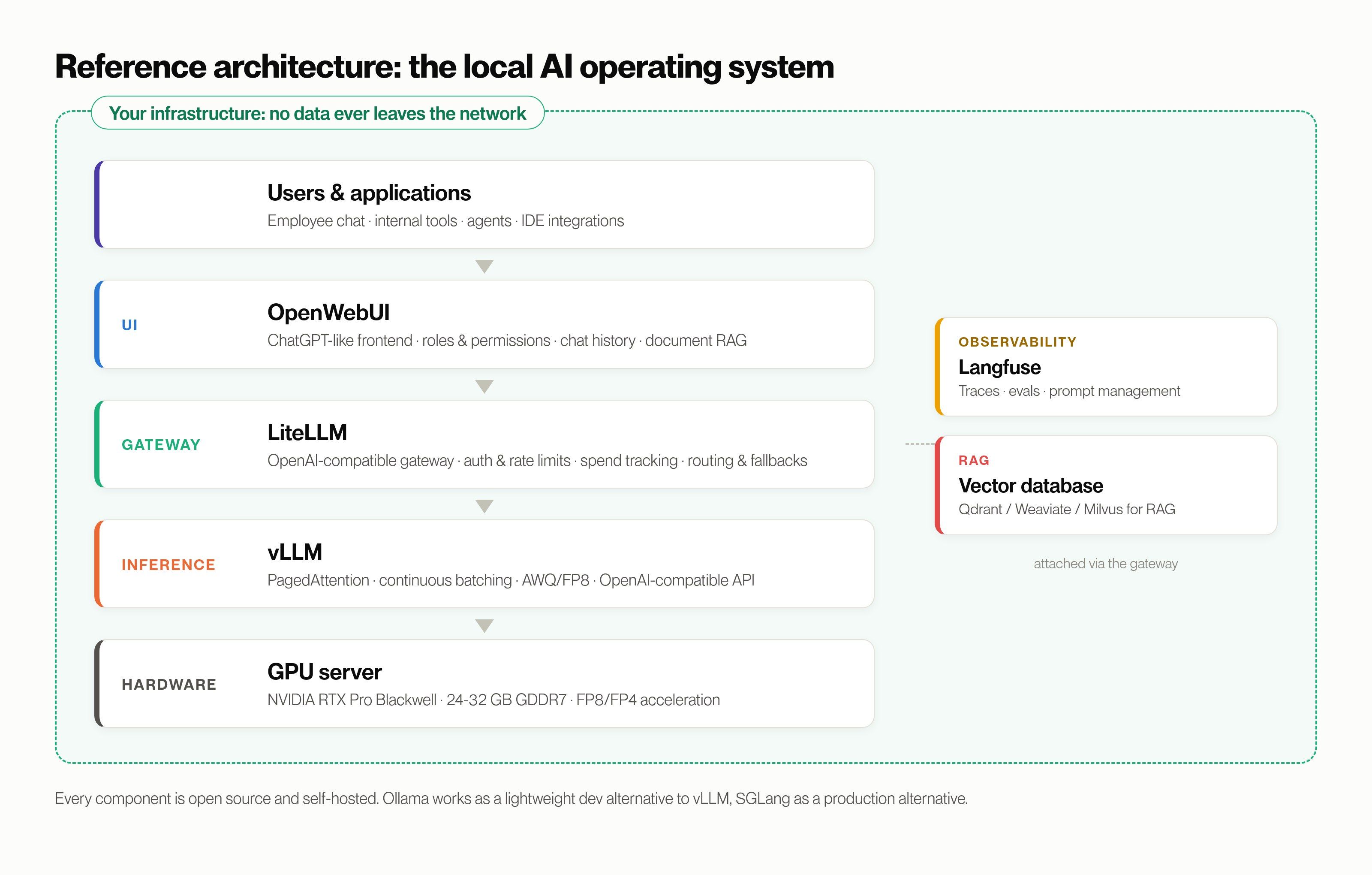
The term describes a software stack that provides, on your own infrastructure, exactly the functions you would otherwise buy from a cloud API: model serving, routing, access control, logging and a frontend for your teams. The reference architecture that established itself in 2025/2026 consists of four layers plus a vector database for RAG. According to several hands-on guides, it can be set up in under an hour.
The roles in detail:
- vLLM (inference): Born at UC Berkeley. Its core innovation, PagedAttention, manages the KV cache in small, dynamically allocated blocks, analogous to virtual memory in an operating system. Add continuous batching, prefix caching, tensor parallelism and an OpenAI-compatible API, and you have the default recommendation for production.
- LiteLLM (gateway): An open-source proxy that unifies more than 100 model providers behind the OpenAI schema. Central authentication, rate limiting, spend tracking, model routing, automatic fallbacks and audit logging through a single endpoint, with full data ownership since it is self-hosted.
- Langfuse (observability): LLM traces, evals, prompt management and metrics, self-hostable via Docker or Kubernetes. Langfuse was acquired by ClickHouse in January 2026; CEO Marc Klingen has publicly confirmed that the MIT license and the self-hosting option will remain.
- OpenWebUI (frontend): A ChatGPT-like interface with user management and roles, persistent chat history, document RAG and tool support. It connects to any OpenAI-compatible backend.
Which inference server for which job?
| Server | Strength | Use case |
|---|---|---|
| vLLM | PagedAttention, continuous batching, highest throughput | Production |
| SGLang | RadixAttention, strong prefix caching | Production alternative |
| Ollama | Easiest entry (ollama pull), automatic quantization | Development, low concurrency |
| llama.cpp | GGUF quantization, runs on CPU | Edge, resource-constrained environments |
| TensorRT-LLM | Maximum throughput on NVIDIA hardware | Only with high operational maturity |
| TGI (Hugging Face) | In maintenance mode since December 2025 | No longer for new projects |
Important for new projects: Hugging Face put TGI into maintenance mode in December 2025 and explicitly recommends vLLM or SGLang as alternatives. The GitHub repository was archived in March 2026.
The difference between development and production servers only shows under parallel load. Benchmarks with Llama 3.1 8B on an RTX 4090 (Clore.ai): with a single user, Ollama delivers 65 tokens/s and vLLM 140. With ten parallel users, Ollama processes around 150 tokens/s in total because requests are handled largely sequentially, while vLLM reaches 800 tokens/s. A comparative study from November 2025 (arXiv 2511.17593) measures 15,243 tokens/s for vLLM versus 4,156 for TGI on LLaMA-2-7B with 100 concurrent requests; under extreme load (around 200 users) the lead grows to as much as 24x. The rule of thumb: Ollama for the laptop and prototyping, vLLM for the server.
Why local? Compliance is the strongest argument
On-premises means no data ever leaves your network: compliant by design. Cloud APIs typically retain inputs for around 30 days for abuse monitoring, and several providers train on user inputs by default unless you opt out.
CLOUD Act vs. GDPR: a structural conflict
The US CLOUD Act of 2018 allows US authorities to access data held by US companies regardless of where it is physically stored, including in EU data centers. That EU data residency does not solve the problem was demonstrated publicly in 2025: Anton Carniaux, Director of Public and Legal Affairs at Microsoft France, was asked under oath before the French Senate in June 2025 whether he could guarantee that data of French citizens would never reach US authorities without consent. His answer: "Non, je ne peux pas le garantir" ("No, I cannot guarantee that").
The EU-US Data Privacy Framework is currently valid but under appeal at the European Court of Justice. Two predecessor frameworks (Safe Harbor, Privacy Shield) have already been struck down. If you plan long-term, bet on sovereignty rather than on the durability of the current agreement.
Regulatory pressure keeps compounding
- GDPR: According to the DLA Piper GDPR Fines and Data Breach Survey (January 2026), cumulative fines since 2018 add up to 7.1 billion euros. The largest single fine to date, 1.2 billion euros against Meta Platforms Ireland, was issued over unlawful EU-US data transfers.
- EU AI Act: In force since August 2024, GPAI rules since August 2025, and the high-risk regime applies from August 2, 2026. Fines reach 35 million euros or 7% of global annual revenue. High-risk systems must demonstrate audit logs, risk assessment and human oversight; on-premises gives you direct control over all three.
- DORA (since January 2025, financial sector): demands full visibility and audit rights across the entire IT supply chain.
- NIS2: extended cybersecurity obligations for energy, healthcare, manufacturing, pharma and logistics, with liability at management level.
- EU Data Act (since September 2025): regulates industrial data and prohibits vendor lock-in.
For companies in regulated industries, local infrastructure resolves these requirements structurally instead of containing them contractually: there is simply no third-party processor left to audit.
The cost question: strictly volume-dependent
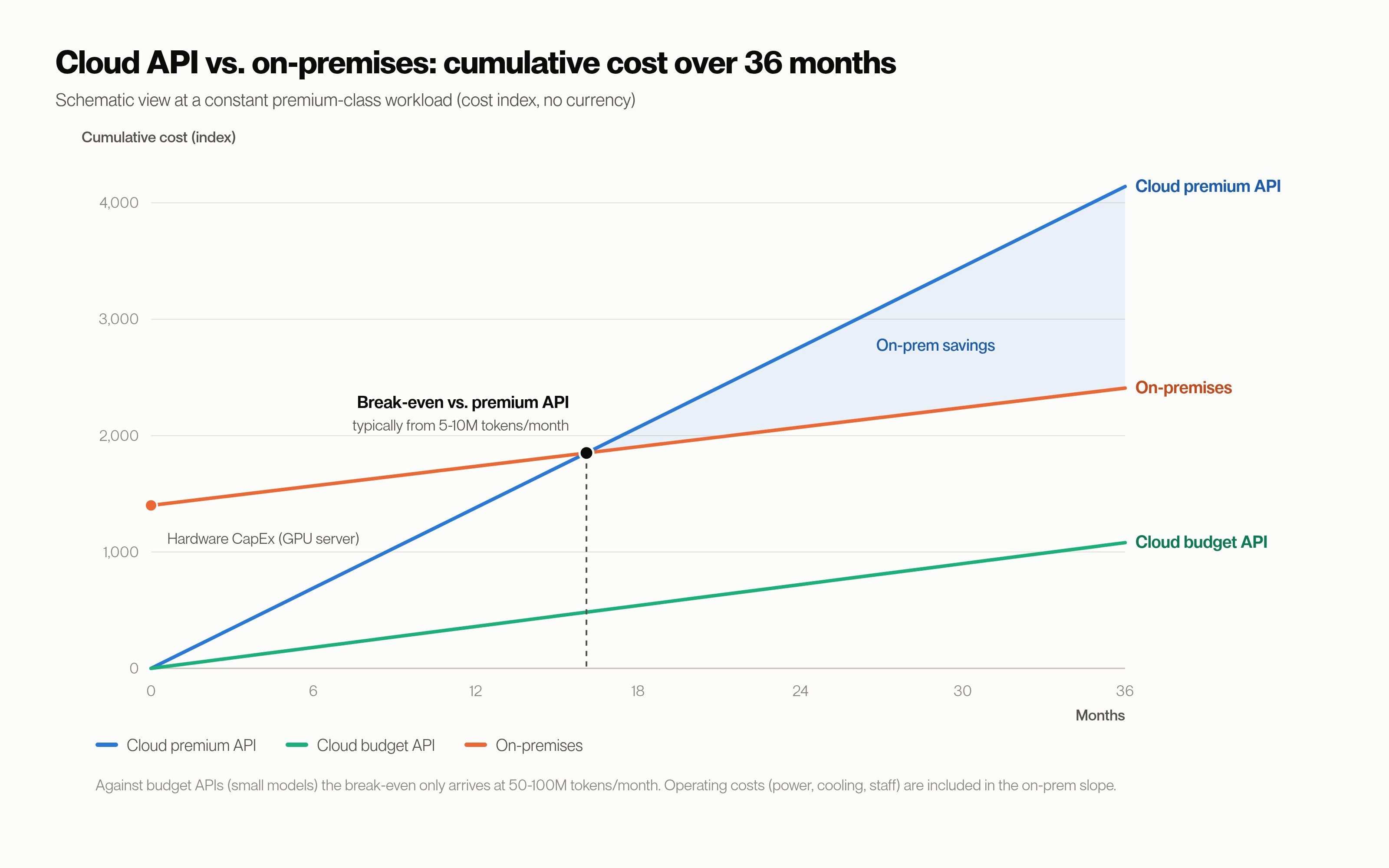
The cost advantage of self-hosting is real, but it is not automatic. Cloud costs grow linearly with volume; on-prem costs are essentially fixed hardware costs plus a flat operating expense.
The key thresholds from current TCO analyses:
- Against premium APIs (GPT-4o class, Claude Sonnet), break-even typically arrives at 5-10 million tokens per month.
- Against budget APIs (DeepSeek, GPT-4o-mini), only at 50-100 million tokens per month.
- A study across 54 deployment scenarios (arXiv 2509.18101) finds break-even for small models often within 3 months, mid-size models in 6-24 months, and large models beyond 2 years.
- SitePoint's 36-month TCO model (heavy tier) calculates an effective ~7.15 USD per million tokens self-hosted versus 6.90 USD (OpenAI) and 9.86 USD (Anthropic). With hardware fully depreciated, the math tips toward on-prem in years 2-3.
Honest math also means pricing in the hidden items: power and cooling (40-54% of total data center power), ML infrastructure staff, and hardware depreciation belong in every TCO calculation. Cost models vary widely with input/output ratios, utilization and electricity prices. Always recalculate with your own workload.
Latency and independence as a bonus
Local inference avoids network round trips: time-to-first-token under 100 ms is achievable, while cloud calls carry at least ~300 ms of network overhead. For agents that execute several tool calls per task, this adds up quickly. On top of that come free model choice, LoRA/QLoRA fine-tuning on your own domain, and protection from unannounced price or API changes.
Which model runs on 24 GB of VRAM?
First, a hardware note that regularly causes confusion in project conversations: NVIDIA officially lists the RTX Pro 4500 Blackwell with 32 GB of GDDR7 (896 GB/s, Blackwell architecture with native FP8/FP4 support). The 24 GB card in the lineup is the RTX Pro 4000 Blackwell (24 GB GDDR7, 70-140 W). We size conservatively for 24 GB here; 32 GB adds headroom for KV cache and longer contexts.
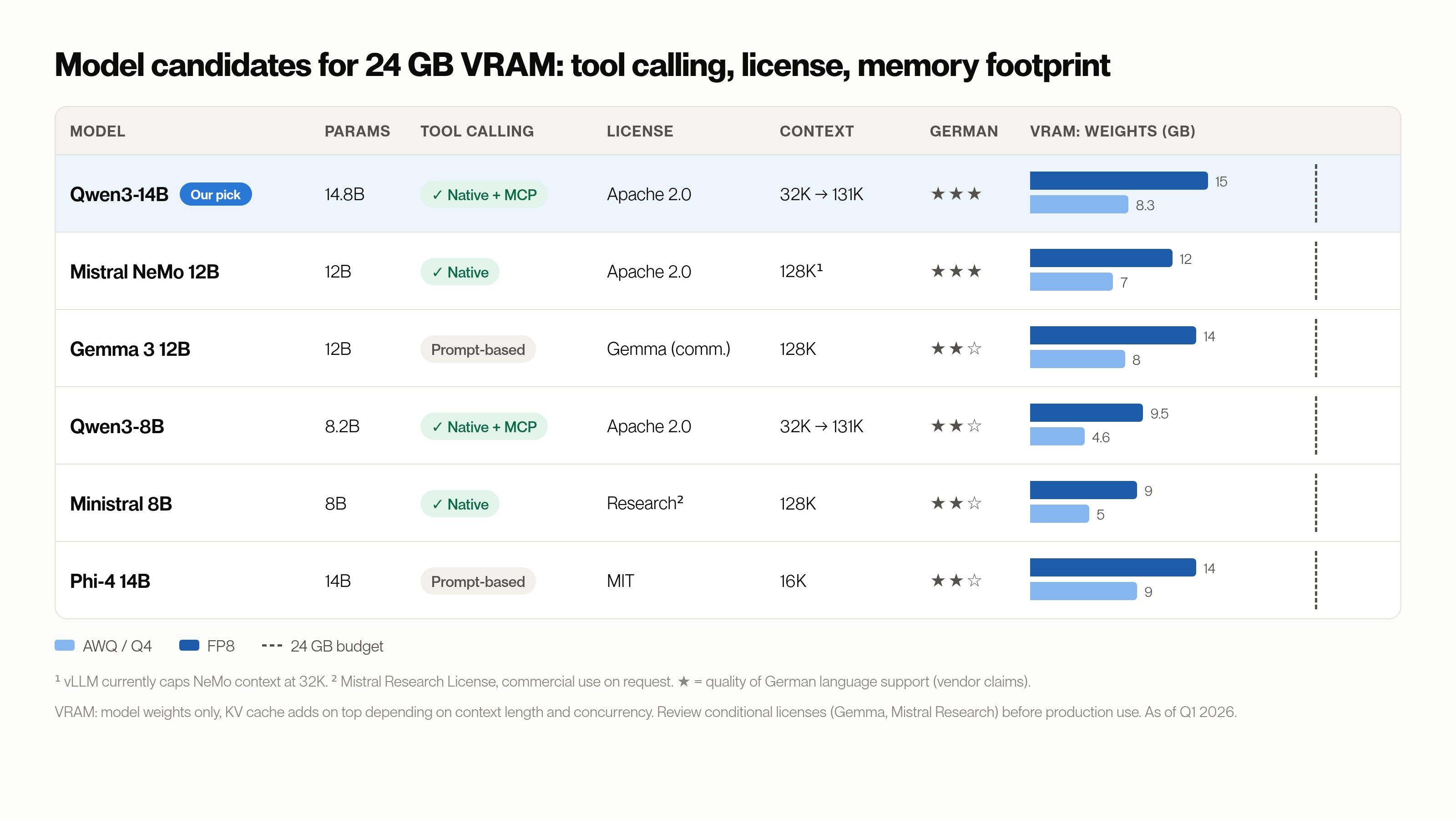
The VRAM rule of thumb: (parameters x bits per weight) / 8 = GB for the weights, plus KV cache, which grows linearly with context length and batch size. FP16 takes about 2 bytes per parameter, FP8 1 byte, INT4/AWQ 0.5 bytes. Practical best practice for vLLM: AWQ-INT4 or FP8; FP8 is natively accelerated on Blackwell GPUs.
| Model | Params | Tool calling | License | VRAM (AWQ/Q4) | VRAM (FP8) | Context | BFCL (version) |
|---|---|---|---|---|---|---|---|
| Qwen3-14B | 14.8B | Native + MCP | Apache 2.0 | ~8.3 GB | ~15 GB | 32K, 131K via YaRN | ~70% (v3, to be verified) |
| Qwen3-8B | 8.2B | Native + MCP | Apache 2.0 | ~4.6 GB | ~9.5 GB | 32K, 131K via YaRN | 65.9% (v3) |
| Mistral NeMo 12B | 12B | Native | Apache 2.0 | ~7 GB | ~12 GB | 128K (vLLM: 32K) | no clean overall score published |
| Gemma 3 12B | 12B | Prompt-based | Gemma (commercial with conditions) | ~8 GB | ~14 GB | 128K | 41.4% (v4) |
| Ministral 8B | 8B | Native | Mistral Research | ~5 GB | ~9 GB | 128K | 40.9% (v4) |
| Phi-4 14B | 14B | Prompt/structured | MIT | ~9 GB | ~14 GB | 16K | 40.8% (v3) |
A word on the BFCL numbers (Berkeley Function Calling Leaderboard, the standard benchmark for tool calling): scores from different versions are not directly comparable. BFCL v4 weights multi-turn and agentic tasks much more heavily, which is why models with excellent single-turn behavior (Gemma 3 12B and Ministral 8B reach over 90% there) fall back to around 40% overall. Some figures are vendor-reported; verify the Qwen3-14B score directly at gorilla.cs.berkeley.edu before making a purchasing decision.
Our recommendations for business use (RAG, agents, tool use)
- First choice: Qwen3-14B (AWQ or FP8). The most reliable native function calling in the segment, MCP-compatible, Apache 2.0 license, a switchable thinking mode and strong multilinguality including German. With AWQ (~8.3 GB of weights) there is plenty of KV cache headroom on 24 GB; on 32 GB the model runs comfortably in FP8.
- For a maximally free license plus German: Mistral NeMo 12B. Apache 2.0, native tool calling (vLLM parser mistral), explicitly trained on German and built quantization-aware for FP8 inference. Limitation: vLLM currently caps the context at 32K.
- For vision and the broadest language coverage: Gemma 3 12B. 140+ languages, 128K context, integrated vision encoder. Tool calling is prompt-based only, so it is less reliable for structured agents, but strong for RAG and multimodal tasks.
- As a sovereignty statement: Teuken-7B (OpenGPT-X/Fraunhofer). Apache 2.0, all 24 official EU languages, around 50% non-English training data, commercialized by T-Systems and IONOS. But: only 7B parameters, 4K context, no strong tool calling. Interesting as a German-sensitive RAG building block, not as a core agent model.
Before production, put a license check on the list: Gemma and GLM licenses allow commercial use with conditions, and Ministral 8B sits under the Mistral Research License and may require a commercial license for production. Qwen3, Mistral NeMo, Phi-4 (MIT) and Teuken-7B are unrestrictedly permissive.
The pragmatic roadmap: three stages to owning your AI
Model quality is no longer the blocker in 2026. The decision is about economics, control and operational capability, and it does not have to be binary:
| Stage | Threshold | Recommendation |
|---|---|---|
| 1. Pilot | < 5M tokens/month, non-critical data | Cloud or hybrid remains rational: fast start, collect real usage data |
| 2. Migration | > 10M tokens/month or regulated data (finance, healthcare, legal, public sector) | On-prem clearly superior: single-GPU deployment, e.g. Qwen3-14B on 24/32 GB |
| 3. Scale | > 50M tokens/month | Multi-GPU plus hybrid routing: 70-80% of the baseline local, burst loads to the cloud |
One point belongs in any honest assessment: on-prem moves operational risk in-house. 24/7 operations, GPU failures, monitoring and security patching require MLOps competence. This is exactly where a local AI operating system either becomes a sovereignty win or a permanent construction site.
Conclusion
In 2026, the local AI operating system is no longer an experiment but a manageable stack of mature open-source components: vLLM for inference, LiteLLM as the gateway, Langfuse for observability, OpenWebUI as the frontend. The CLOUD Act conflict and the EU AI Act timeline with its high-risk regime starting in August 2026 make data sovereignty a board-level topic, and from 5-10 million tokens per month the economics work out against premium APIs as well.
If you want to know where your company sits on that curve: NexPatch supports the entire journey, from a break-even analysis with your real usage data through the reference architecture to managed operations. Get in touch.