

Scaling AI pilots: why four in five use cases never leave the pilot phase
Scaling AI pilots means moving a proven use case into permanent everyday operations and then rolling it out to further lines or plants. In manufacturing, this has so far succeeded for only 20 % of use cases (Deloitte 2026). The bottleneck is rarely the technology. It lies in data access, baselines, operational ownership and the order of the steps.
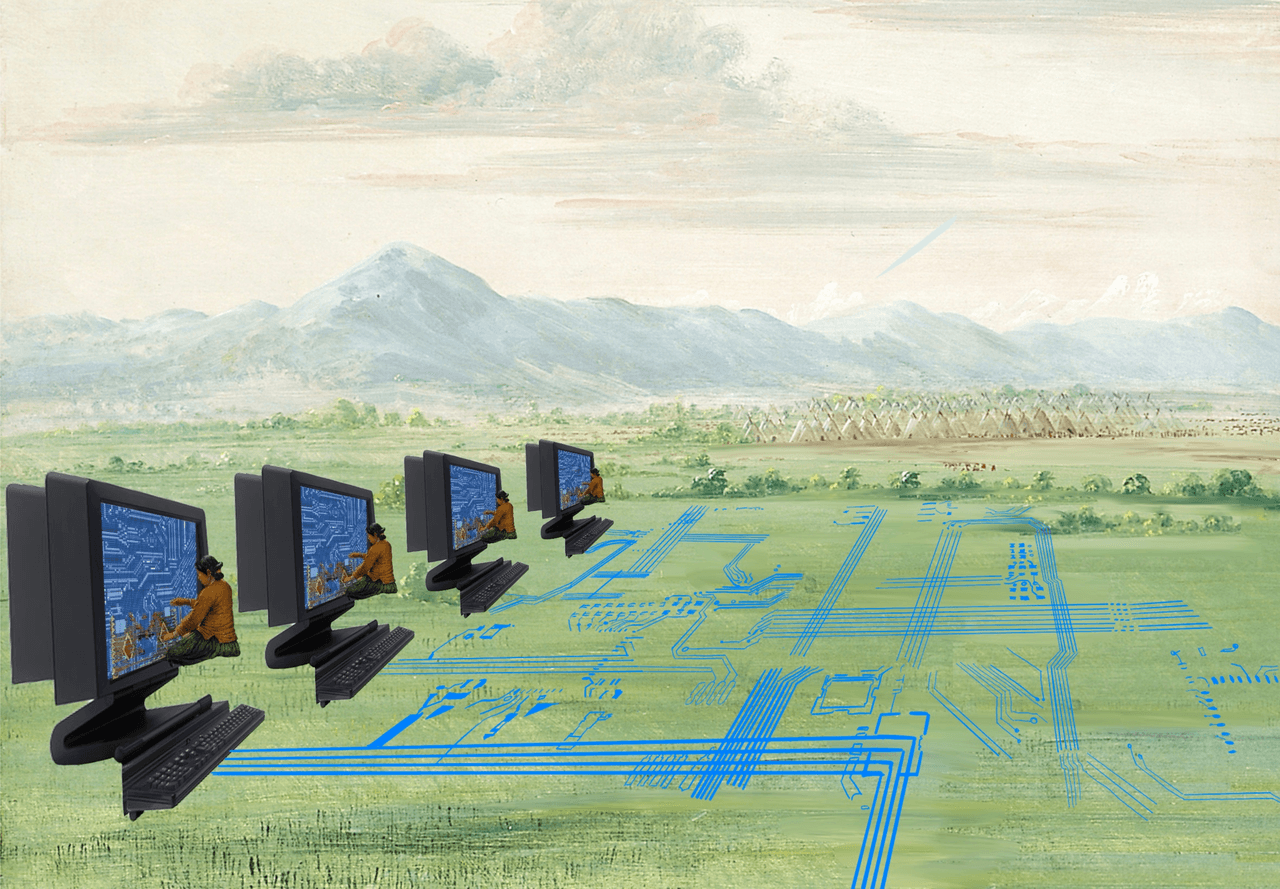
Image: Hanna Barakat & Archival Images of AI + AIxDESIGN / Weaving Wires 2 / Licenced by CC-BY 4.0
For decision makers in brief
- Situation: 58.7 % of companies in manufacturing use AI (ifo Institute, May 2026), yet only one use case in five has been rolled out across the company (Deloitte 2026, consulting study).
- Effort: The largest effort is not the model, it is data integration, process adjustment and operations. According to Capgemini 2025 (consulting study), 80 % of data and AI initiatives in industry first need investment in technical foundations.
- Cost: Broad platform programmes reach a satisfactory return after two to four years on average, narrowly scoped individual use cases after three to twelve months (Deloitte 2025, consulting study).
- Risk: Without defined operational ownership, a model loses its value again over time. The pilot then ends up as a one-off without an owner.
- Consequence: One use case, one baseline, regulated operations, and only then the rollout.
The scaling gap in figures
The adoption figures of recent years look impressive. According to the ifo Institute's business survey (ifo Konjunkturumfrage), the share of industrial companies using AI rose from 17.3 % in June 2023 to 58.7 % in May 2026, based on around 6,000 companies surveyed. Manufacturing is therefore above the economy-wide average of 54.5 %. This figure, however, measures who has started, not who has arrived.
As soon as the question is framed more narrowly, the picture shrinks. The following table brings together the stages as documented in our industry report "AI in Manufacturing". It draws on, among others, Bitkom, the German digital industry association, and the German Economic Institute (IW Köln).
| Stage | Value | Base | Source |
|---|---|---|---|
| Use AI at all | 58.7 % | Companies in manufacturing | ifo business survey, May 2026 |
| Use AI in production | 40 % | Industrial companies with 100 or more employees | Bitkom Industrie 4.0 2026, n=555 |
| Use cases scaled across the company | 20 % | Use cases at more than 140 manufacturers | Deloitte AI in Manufacturing 2026 |
| Actually run AI in manufacturing at scale | 5 % | Industrial companies | Capgemini 2025 (consulting study) |
| Use AI across all business areas | 2.2 % | Companies | IW Köln 2025 |
One point matters for interpretation: the values come from different surveys with different populations. They show a direction, not an exact funnel. The direction, however, is clear.
The value from Bitkom is worth noting: 40 % use AI in production, after 42 % the year before. That lies within the margin of error, so use on the line is stagnating. The growth in the overall rate comes mainly from administration, sales and software development. In mechanical and plant engineering the gap is particularly visible: 43 % use AI in the company (VDMA, the German mechanical engineering association, 2025), yet only 13 % in their own production (Fraunhofer ISI 2024).
Why the value is nevertheless real
The low scaling rate is no evidence that AI delivers little in manufacturing. Where AI runs in production, 84 % of manufacturers report measurable value (Deloitte 2026, consulting study). The problem is not the effect, it is the spread.
A figure often quoted in this context comes from the MIT NANDA report of July 2025, according to which 95 % of generative AI solutions in companies achieve no measurable effect on results. The study is not peer reviewed and has been widely criticised on methodological grounds. For the same statement, the Deloitte figure of 20 % scaled use cases is the more robust basis.
Where AI pilots get stuck in practice
If you want to succeed at scaling AI pilots and moving AI into production, you need to understand where the transition breaks. The surveys and our analysis of 52 published practitioner conversations (September 2025 to August 2026) reveal four recurring breaking points.
Breaking point 1: no baseline before the start
Only 14 of the 52 conversations analysed mention a result with a robust figure at all. If the starting value was not recorded before the pilot, success cannot be proven afterwards. Without proof there is no second budget, and without a second budget no rollout to further plants.
Breaking point 2: the foundation is missing
According to Capgemini 2025, 80 % of data and AI initiatives in industry require upfront investment in data architecture, OT/IT integration and interfaces. This item does not appear in many proposals. The pilot runs on a special solution that cannot be transferred to plant two.
Breaking point 3: nobody runs the system
In our analysis of the practitioner conversations, there is a lot of talk about use cases and almost none about where the model runs, who operates it and how operations are safeguarded. Models deteriorate over time as data and processes change. If you do not define operational ownership, you lose the value again after about twelve months. This is exactly the gap addressed by regulated AI operations as a managed service, in which monitoring of model quality, retraining and documentation are defined.
Breaking point 4: people and rules come too late
Philippe Rambach, Chief AI Officer at Schneider Electric, puts the share of change management, training and workflow redesign in an AI transformation at 80 to 90 percent (company statement, April 2026). If the works council is only involved before the rollout instead of before the pilot, the rollout is regularly delayed.
The right sequence for scaling AI pilots
From its findings, the industry report derives a simple sequence: first clarity about data and rules, then a single use case with a short payback period, then operations, and only after that scaling. If you start with a platform, a strategy paper and a flagship model, you walk into pilot purgatory and are very likely to end up among the 80 % that never leave pilot status.
| Phase | Goal | Typical result |
|---|---|---|
| Foundation | Inventory, data classification, usage rules | Clarity about which data may leave the company |
| First value | One use case with a baseline, parallel operation | Proven effect against the starting value |
| Operations | Ownership of model quality, retraining, shutdown | Stable everyday operations instead of a pilot without an owner |
| Scaling | Transfer the same case to plant two, line two | Repetition instead of broadening |
Two points deserve particular attention. First, scaling means repetition, not broadening. The proven use case is transferred to the next line, the next plant or the next document type. Second, the pilot must be built to be transferable from the outset, otherwise the work starts from scratch every time.
You will find detailed guidance with checkpoints for every phase in our guide from pilot to operations.
What a scalable pilot needs
From the findings, requirements can be derived for a pilot that can later go to scale:
- A use case with clear edges, selected by business criticality, not by where data happens to be available.
- A single metric with a baseline from the previous year, defined before the start.
- A parallel operation in which the AI proposes and a person decides, until quality has been stable for weeks.
- An architecture that can be transferred to further plants, instead of a one-off solution.
- Defined operations with responsibilities, response times and documentation.
For the last point, it is worth looking at an agreed SLA for AI systems. It defines who responds in the event of a fault and within what time. We work with an operations target of 99.9 % as a general benchmark, not as an individual guarantee.
Predictable delivery also plays a role. A use case that can be implemented within a few weeks delivers the proof that the next budget needs more quickly. The page on our AI project fixed price shows what a framework with 72 hours to the first pilot and 4 to 10 weeks of implementation looks like.
How we organise infrastructure, delivery and operations from a single source is shown in our overview of AI delivery for the Mittelstand.
Frequently asked questions
What does it mean to scale an AI pilot?
A pilot is scaled when it moves from test mode into permanent everyday operations and is then transferred to further lines, plants or document types. What matters is that operations, ownership and documentation are regulated. A pilot that runs in only one place is not considered scaled.
How many AI use cases in manufacturing are scaled?
According to Deloitte AI in Manufacturing 2026, a consulting study covering more than 140 manufacturers, only one use case in five has been rolled out across the company. IW Köln found for 2025 that only 2.2 % of companies use AI across all relevant business areas.
What most often causes scaling to fail?
In our analysis of the practitioner conversations, 42 of 206 pain point statements concern data, IT/OT and integration, and a further 32 concern leadership, culture and change. Technology as such hardly appears as a problem. Missing baselines and unregulated operations add to this.
How long does it take for a scaled use case to pay off?
Broad platform programmes need two to four years on average to reach a satisfactory return, and only 6 % manage it in under twelve months (Deloitte 2025, consulting study). Narrowly scoped cases such as predictive maintenance, by contrast, often pay for themselves within three to twelve months.