Agentic AI (or "agentic AI") refers to AI systems that act as autonomous agents, independently pursuing goals and making decisions. Unlike classical rule-based automations or simple chatbots, these agents have memory and can independently use tools (e.g., APIs, databases). In multi-agent systems, multiple specialized agents work together in a coordinated manner, controlled by a central orchestrator, to handle complex processes.
Definitions and Distinctions
Agentic AI encompasses AI systems that work independently with minimal human oversight, pursuing goals and making decisions along the way. An "AI agent" can act like a digital employee: it receives a goal as input and independently takes over planning, execution, and prioritization.
The concrete components of an agent typically include:
- An LLM (e.g., GPT-4 or Gemini) for reasoning
- Memory for storing context
- Tool integration for APIs, databases, or specialized models
Agentic AI differs from classical automation forms and RAG/LLM solutions: Traditional RPA or rule-based workflows follow fixed sequences with predefined decision points. Agentic agents, by contrast, are goal-oriented — they decompose an overarching goal into sub-steps themselves and make situational decisions about the next step.
Compared to RAG (Retrieval-Augmented Generation) — where an LLM is enriched through data retrieval — agents go further by being able to actively act (e.g., interact via APIs, write to systems, send emails).
Technical Architecture

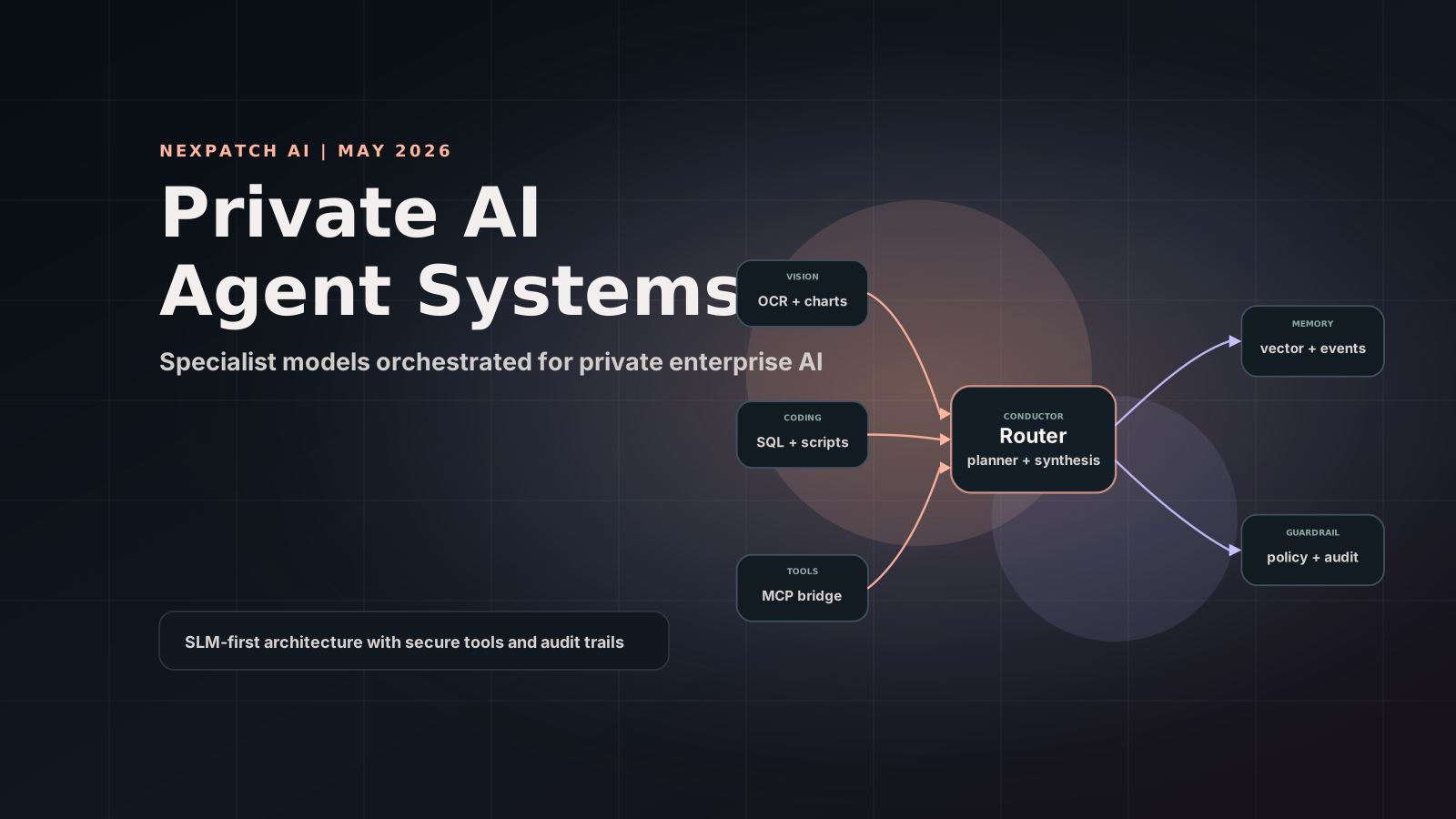
The Agentic AI architecture is typically based on Multi-Agent Systems (MAS). Here, a central orchestrator coordinates communication between multiple specialized agents, each designed for specific functions or sub-tasks. The orchestrator receives user requests, obtains input/triggers, and maintains the context (state) of the interaction. It delegates sub-tasks to suitable agents, collects their results, and performs further iterations as needed.
Plan–Act–Observe–Adjust
The agent-controller loop follows the Plan–Act–Observe–Adjust model: an agent receives a goal/trigger, plans the next steps using an LLM, executes actions via tools or APIs, observes the result, and adjusts its plan. The agents act as "translators" between human instructions and technical systems.
Workflow Diagram
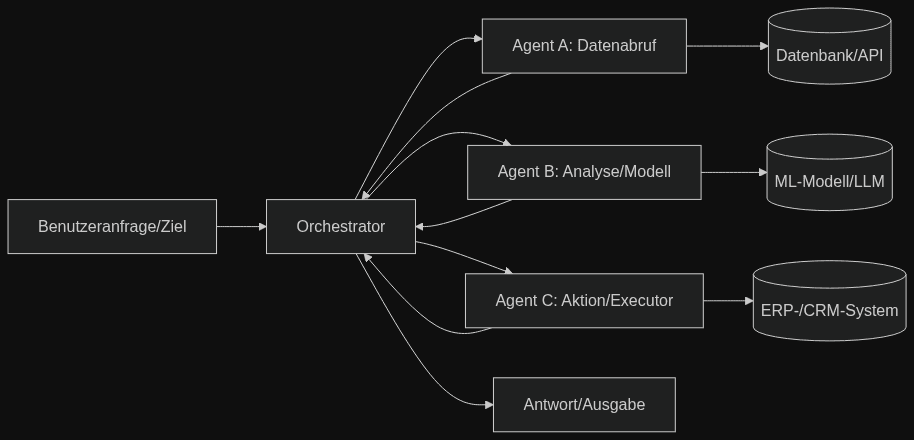
Feature diagram of an agentic workflow with orchestrator and specialized agents. Agents access data sources or business applications via APIs and feed outputs back to the orchestrator.
Multi-agent systems are characterized by multiple agents working together — cooperating, coordinating, or even competing — to achieve goals too complex for a single agent. For secure interaction, each system uses a controlled tool and connector layer that converts external systems into safely callable actions.
Implementation Approaches
Agentic AI can be implemented both on-premise and in the cloud. Modern platforms such as SAP Business AI or Microsoft Semantic Kernel work in both environments. Typically, a hybrid architecture is used: the orchestrator and LLMs can run in the cloud while sensitive data remains on-premises.
For licensing, open-source frameworks (LangChain, AutoGPT, LangFlow, Microsoft SK) exist alongside commercial platforms (IBM watsonx, SAP Agent Builder, UIPath AI Center). Open-source tools offer flexibility and no licensing costs but require internal expertise.
Practical Examples and Case Studies

Finance
Modern ERP systems offer embedded AI agents for financial closes. Agents automate routine tasks such as journal entries, reconciliations, and variance analysis. Early adopters report: the monthly close was reduced from over 6 days to 3–4 days. In one example, the duration halved and the error rate dropped from 2–5% to under 0.5%.
Supply Chain & Manufacturing
At Lufthansa Industry Solutions, complex supply chain questions were answered in under 10 seconds. The system orchestrates specialized agents via Microsoft Teams: 80% less idle time in analyses.
E-Commerce/Retail
AI agents automate return processing and customer inquiries. They relieve service teams by pre-filtering tickets and suggesting resolution steps — only complex cases are escalated.
Benefits and KPIs
| KPI | Metric | Description |
|---|---|---|
| Throughput time reduction | Days or % | Comparison of process duration before vs. after |
| Error rate reduction | Percentage points | Deviation rate (e.g., booking entries) |
| Automation degree | Percent | Share of automated process steps |
| Cost reduction | EUR or % | Savings on personnel costs, outsourcing |
| Service level | Sec./min. per transaction | Response time for support requests |
| Employee productivity | % or scaled metric | Time for value-adding tasks |
Risks, Compliance and Ethics
Agentic AI simultaneously increases risk — especially with sensitive data. Under the EU AI Act, Agentic AI is considered an adaptive, autonomous system and may be classified as "high-risk."
Key risks:
- Uncontrollable decisions: Agents make autonomous decisions in real time, which can lead to unpredictable actions
- Transparency requirement: For high-risk systems, the AI Act mandates complete logging (Art. 12–14 AI Act)
- Data protection: Agents aggregate personal data — a privacy-by-design approach is essential
- IT security: Strong access controls, encryption, and sandboxing are necessary
Best Practices and Implementation Recommendations
A typical 5-step plan for successful implementations:
- Clarify vision & goals
- Prioritize use cases (2–3 actionable scenarios)
- Proof of concept with real data
- Establish governance and security policies
- Prepare for scaling
Decision-Maker Checklist
- Are business goals measurably defined?
- Are there suitable processes that benefit from automation?
- Is data available in sufficient quality?
- Can agents be connected to ERP/CRM/workflow systems via API?
- Has a data protection and security concept been developed?
- Are there human-in-the-loop mechanisms for sensitive decisions?
- Has classification under the EU AI Act been reviewed?
- Is a proof of concept with real data and feedback loops planned?
Conclusion
Agentic AI is the next level of enterprise automation. Unlike classical RPA bots or simple chatbots, autonomous agents can independently handle complex, multi-step processes. The key lies in the right architecture (orchestrator + specialized agents), solid governance, and an iterative implementation approach. Companies that start with pilot projects now secure decisive competitive advantages.