Agentic AI in the Enterprise: Architecture, Implementation and the Path to Production
Agentic AI refers to autonomous AI systems that independently pursue goals, plan sub-steps, and execute tasks without direct human oversight. Unlike classical rule-based automations or simple chatbots, these systems have memory, use tools (APIs, databases, specialized models), and dynamically adapt their approach to changing conditions.
The technology is increasingly understood as an operational model. Gartner forecasts that by 2028, about one-third of all enterprise applications will contain agent capabilities and approximately 15 percent of daily business decisions will be made autonomously by agents.
Definitions and Distinctions
An AI agent acts like a digital employee: it receives a goal as input and independently takes over planning, execution, and prioritization. The core components are:
- LLM (Large Language Model) as the reasoning engine for intent recognition and task decomposition
- Memory for storing context across interactions
- Tool Integration for controlled access to APIs, databases, and external systems
The distinction from related technologies is clearly defined:
| Approach | Decision Logic | Capability | Adaptability |
|---|---|---|---|
| Rule-based RPA | Fixed workflows | Predefined actions | None |
| RAG / LLM Assistance | Context-based | Text generation | Limited |
| Agentic AI | Goal-oriented | Autonomous actions | Dynamic |
Agents sit at the top of a continuum: from simple chatbots through generative assistance systems to fully autonomous multi-agent systems that independently handle multi-step business processes.
Technical Architecture: Multi-Agent Systems
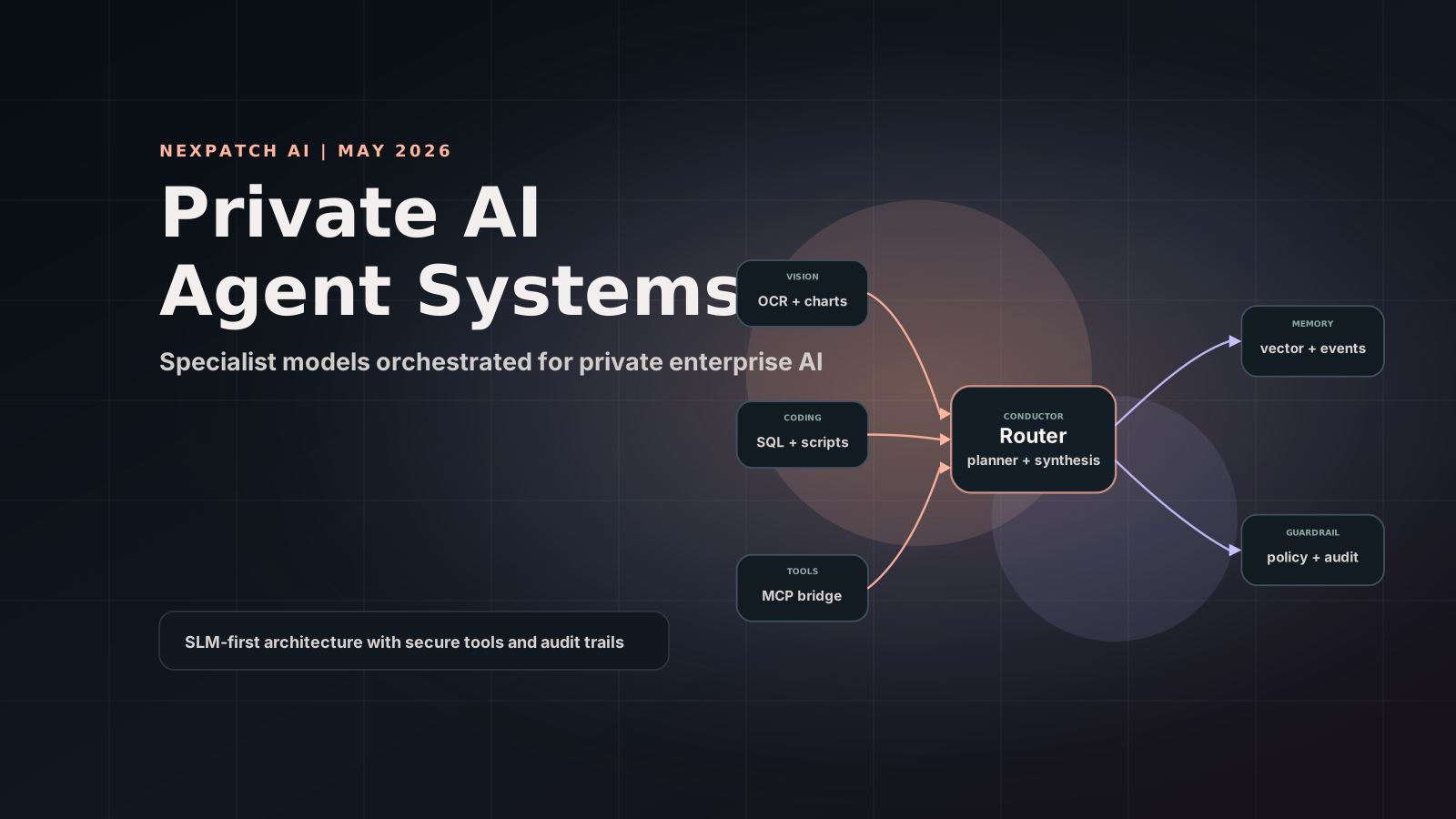
The architecture of production-grade Agentic AI systems is typically based on Multi-Agent Systems (MAS). A central orchestrator coordinates communication between specialized agents, each designed for specific functions or sub-tasks.
The Orchestrator
The orchestrator receives user requests or system triggers, maintains the context (state) of the interaction, and delegates sub-tasks to appropriate agents. It collects their results and, when necessary, performs further iterations.
Plan–Act–Observe–Adjust
The agent-controller loop follows the Plan–Act–Observe–Adjust model:
- Plan: The agent analyzes the goal and decomposes it into sub-steps using the LLM
- Act: Execute concrete actions via tools or APIs
- Observe: Evaluate the result and compare with the target state
- Adjust: Adapt the plan based on the observation
The Tool and Connector Layer
To securely interact with external systems, every MAS uses a controlled tool and connector layer. This layer:
- Converts external systems (databases, ERP, CRM) into safely callable actions
- Enforces permissions following the least-privilege principle
- Logs all actions for transparency and auditability
Protocols such as the Model Context Protocol (MCP) enable structured context exchange between agents and existing enterprise systems.
Implementation Approaches
Agentic AI can be deployed both on-premise and in the cloud. In practice, a hybrid architecture dominates: the orchestrator and LLMs run in the cloud while sensitive enterprise data remains on-premises.
Open Source vs. Commercial Platforms
| Category | Examples | Strengths | Limitations |
|---|---|---|---|
| Open Source | LangChain, AutoGPT, Semantic Kernel | High flexibility, no licensing costs | Requires internal expertise |
| Commercial | SAP Agent Builder, IBM watsonx, UIPath AI Center | Integrated workflows, enterprise support | Higher costs, ecosystem lock-in |
| Custom LLM Stack | GPT-4, Claude, Gemini via API | Most powerful models, maximum flexibility | Ongoing API costs, custom development |
The selection depends on existing infrastructure, internal expertise, and integration requirements. A proof of concept with one to two tools is recommended for performance evaluation.
Practical Examples and Measurable Results
Finance
Embedded AI agents handle routine tasks in financial closes: journal entries, reconciliations, and variance analysis. Early adopters report reducing the monthly close from over six to three to four days. In one documented case, the duration halved and the error rate dropped from 2–5 percent to under 0.5 percent. According to Deloitte, 87 percent of CFOs consider AI essential and 54 percent plan to deploy agents in the finance function.
Supply Chain and Manufacturing
At Lufthansa Industry Solutions, a multi-agent system answered complex supply chain questions in under ten seconds. The result: 80 percent less idle time in analyses and a company-wide agent cockpit accessible via Microsoft Teams.
Content Operations and Customer Service
AI agents automate content planning (from trend analysis and research to performance evaluation) and customer service (prioritization, response suggestions, escalation logic). Project management agents reduce administrative overhead by 30–40 percent. In finance back-office operations, agents process invoices in seconds instead of hours.
E-Commerce and Insurance
Service agents relieve teams through automatic ticket filtering, resolution suggestions, and selective escalation. In claims management, agents control triage processes and review workflows.
Risks, Compliance and the EU AI Act
The autonomy of agentic systems brings specific risks that must be systematically addressed:
Regulatory Classification: Under the EU AI Act, Agentic AI is considered an adaptive, autonomous system and may be classified as high-risk depending on the deployment context (Art. 6 AI Act). For high-risk systems:
- Transparency requirement: Complete logging of all decision steps (Art. 12–14)
- Human oversight: Human-in-the-loop mechanisms for sensitive decisions (Art. 14)
- Conformity assessment: Formal review before deployment in regulated areas
Data Protection: Agents aggregate personal data from various sources. A privacy-by-design approach is essential: pseudonymization, strictly limited access rights, and regular bias reviews.
IT Security: Through tool integration, agents access IT systems deeply. Strong access controls, encryption, sandboxing, and integration into the existing security architecture are required.
The Path to Production: Implementation Strategy
Successful implementations follow an iterative 5-step approach:
1. Clarify Vision and Goals
Define business goals measurably: cost reduction, throughput time reduction, error reduction. Establish clear KPIs from the outset.
2. Prioritize Use Cases
Select two to three actionable scenarios with high automation potential and clearly definable scope. Ideally, processes with high volume and recurring patterns.
3. Proof of Concept with Real Data
Implement MVP in a sandbox environment with actual operational data. Iteratively optimize prompt configuration, routing logic, and decision rules.
4. Establish Governance and Security
Define responsibilities, implement audit trails, set up monitoring dashboards. The orchestration layer must provide log data sufficient for audits and compliance.
5. Prepare for Scaling
Create roll-out plan for adjacent workflows. Closely align DevOps teams and business units. Continuously develop the architecture roadmap.
How NexPatch Implements Agentic AI
At NexPatch, we develop agentic systems from architecture to production. Our approach combines technical excellence with business experience:
- Architecture Consulting: Multi-agent system design, orchestration architecture, tool integration, and data connectivity
- MVP Development: From pilot process to functional agent system in defined sprints
- Co-Founding Model: For startups and ventures, we offer partnership-based product development with shared risk and joint growth strategy
- Funding Integration: Support with EXIST, ZIM, and INVEST grants to finance the development phase
Decision-Maker Checklist
- Are business goals measurably defined?
- Are there suitable processes with high automation potential?
- Is data quality (internal/external) sufficient?
- Can agents be connected to ERP/CRM/workflow systems via API?
- Has a data protection and security concept been developed?
- Are there human-in-the-loop mechanisms for sensitive decisions?
- Has classification under the EU AI Act been reviewed?
- Is a proof of concept with real data planned?
Conclusion
Agentic AI is not a short-term hype but a structural shift in how enterprises design and automate processes. Multi-agent systems with orchestrator architecture enable a new quality of automation: adaptive, goal-oriented, and scalable. The key lies in a clear implementation strategy, a solid governance framework, and iterative scaling based on measurable results.
NexPatch supports organizations on this journey — from architecture planning through proof of concept to production.
References
- Arvato Systems (2025): AI Agents: Definition, Use Cases and Value for Enterprises
- Databricks (2025): What is Agentic AI?
- IBM (2025): What is AI Agent Orchestration?
- Beam.ai (2025): AI in ERP: Shortening the Financial Close with AI Agents
- Bitkom (2026): Agentic AI in Customer Experience (Whitepaper)
- Flexso (2025): Agentic AI in SAP S/4HANA, Cloud and On-Premise
- CMS Law (2025): Agentic AI, Risk and Compliance Under the EU AI Act
- Deloitte (2025): Agentic AI Strategy
- McKinsey (2025): The Agentic Organization: A New Operating Model for AI