Introduction: Traditional DevOps Is Not Enough
In classical web development, DevOps typically includes:
- CI/CD pipelines
- Automated testing
- Containerization
- Monitoring
- Infrastructure as code
In AI projects, however, additional layers emerge.
Because AI systems deploy not only code —
but also models, data, and experiments.
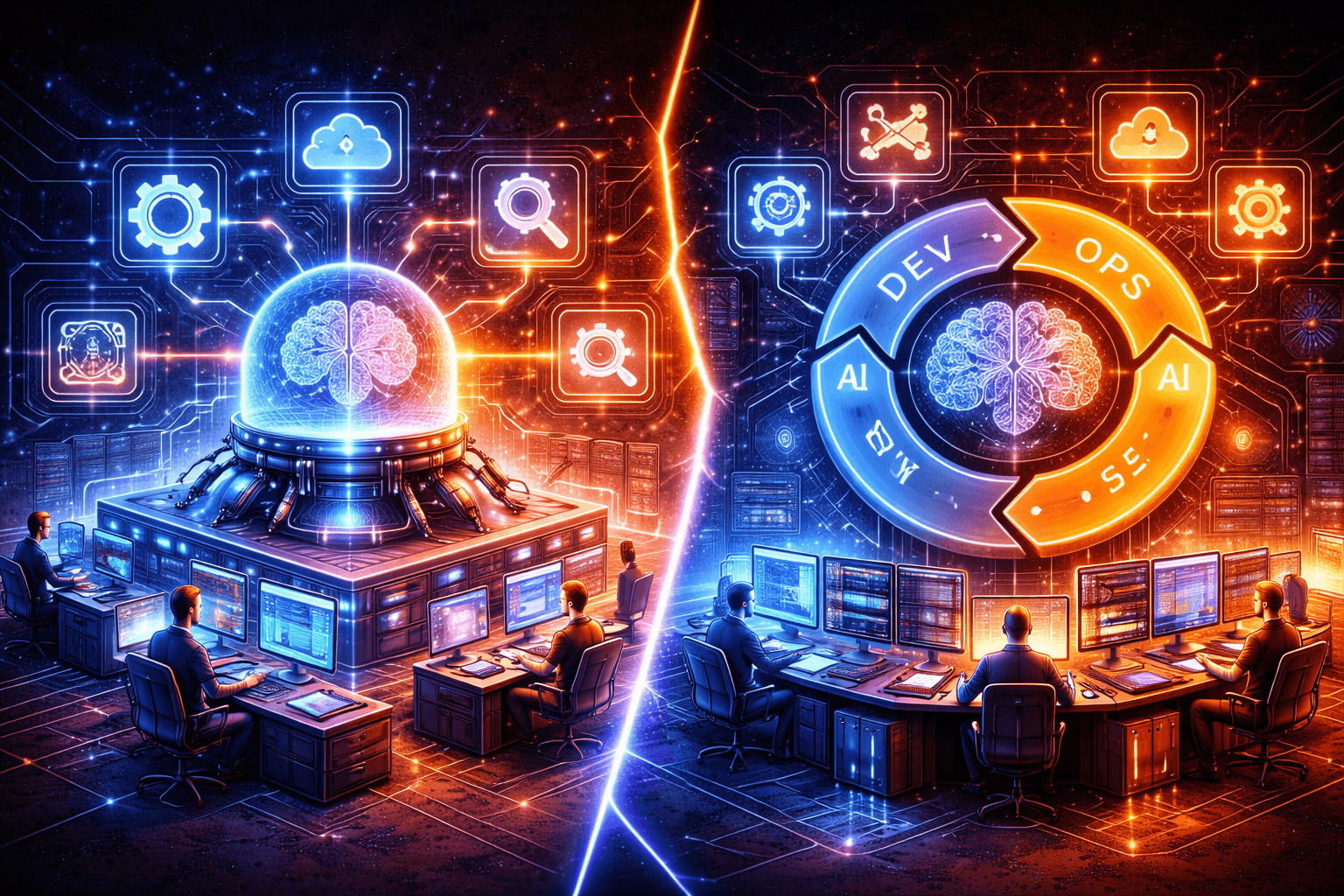
DevOps evolves into MLOps.
Why AI Projects Have Unique Requirements
AI systems differ fundamentally from traditional applications:
- Models evolve
- Data changes continuously
- Performance drifts over time
- Outputs are probabilistic
Deployments are not static.
They require continuous oversight.
DevOps vs. MLOps
DevOps focuses on:
- Code
- Infrastructure
- Application deployment
MLOps extends this to include:
- Data versioning
- Model versioning
- Experiment tracking
- Performance monitoring
- Drift detection
MLOps = DevOps + data governance + model lifecycle management.
Core Challenges in AI DevOps
1. Model Versioning
Models must be:
- Reproducible
- Version-controlled
- Documented
Without versioning, organizations face:
- Inconsistent predictions
- Compliance risks
- Debugging complexity
2. Data Versioning
Training data evolves.
When data changes, model behavior changes.
Therefore:
- Data snapshots
- Historical traceability
- Transparency
are critical.
Data is part of deployment.
3. Experiment Tracking
Training is iterative.
It generates:
- Multiple model variants
- Different hyperparameters
- Alternative dataset configurations
Experiment tracking ensures comparability and transparency.
4. Continuous Training vs. Continuous Deployment
In web development, CI/CD means:
Code is tested and deployed.
In AI, it additionally means:
- Automated retraining pipelines
- Validation processes
- Performance gates
Not every new model should automatically go live.
Monitoring in AI Systems
Monitoring must include:
- Infrastructure performance
- Model accuracy
- Data drift
- Prediction drift
- Resource utilization
A model can be technically stable —
but functionally wrong.
AI monitoring requires dual-layer oversight.
Infrastructure as Code in AI
AI workloads require:
- GPU allocation
- Scalable clusters
- Container orchestration
- Batch and real-time processing
Infrastructure as code ensures:
- Reproducibility
- Automation
- Scalability
Security and Compliance Considerations
AI systems often process sensitive information.
Important aspects include:
- Access control
- Model auditability
- Decision traceability
- Regulatory compliance (e.g., GDPR)
AI DevOps is also governance.
Practical Example
A company deployed an ML model manually.
Issues included:
- No version control
- No monitoring
- Undetected performance drift
- Lack of transparency
After implementing MLOps practices:
- Automated model versioning
- Performance dashboards
- Drift detection systems
- CI/CD for model updates
Results:
- Improved stability
- Faster iteration cycles
- Stronger compliance posture
DevOps became strategic risk management.
Common Mistakes
- Treating AI models like standard code
- Ignoring data governance
- No monitoring strategy
- Manual deployment processes
- Lack of reproducibility
AI without MLOps introduces operational risk.
ROI Perspective
Structured DevOps for AI reduces:
- Operational risks
- Performance degradation
- Downtime
- Compliance exposure
And improves:
- Stability
- Scalability
- Innovation speed
Conclusion
DevOps for AI is more than deployment.
It includes:
- Model lifecycle management
- Data governance
- Infrastructure control
- Regulatory compliance
Organizations deploying AI in production
must build MLOps capability.