Introduction: The Limitation of Generic Language Models
Large language models are powerful. They generate text, summarize content, and answer complex questions within seconds.
However, they have a critical limitation:
They do not know your company’s internal data.
A generic model has no direct access to:
- Internal policies
- Product databases
- Contracts
- Historical customer records
- Technical documentation
This is where Retrieval-Augmented Generation (RAG) becomes essential.
What Is Retrieval-Augmented Generation?
RAG combines two core components:
- A large language model (LLM)
- An external knowledge source
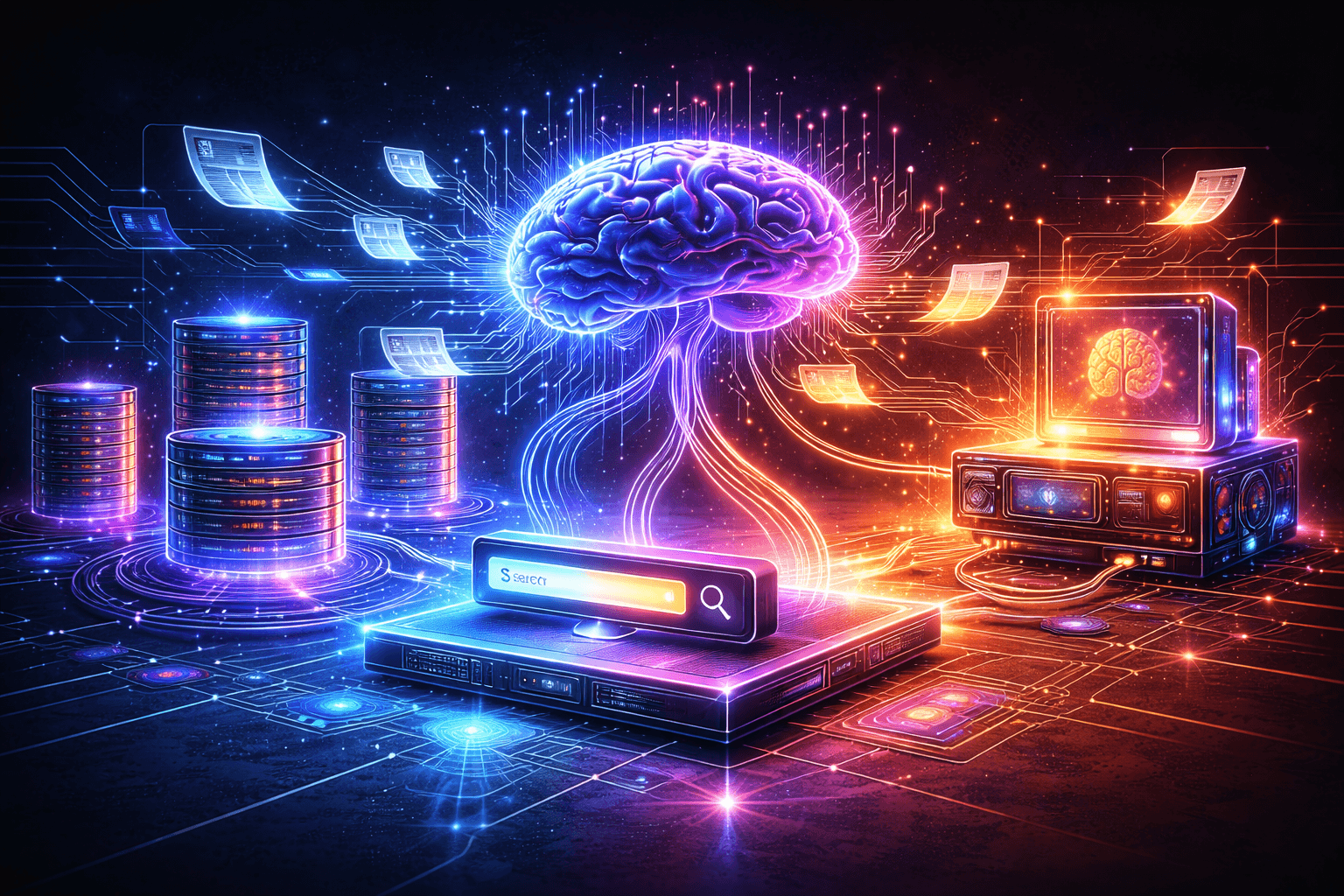
Instead of generating answers solely from pre-trained knowledge, the system retrieves relevant documents from a structured database and feeds them into the model as context.
The workflow typically follows these steps:
- A user asks a question
- The system searches relevant documents
- Retrieved content is embedded into the model’s prompt
- The model generates a context-aware response
This significantly reduces hallucinations and improves factual accuracy.
Why RAG Matters for Enterprises
RAG enables organizations to:
- Leverage internal knowledge
- Use up-to-date information
- Increase answer traceability
- Reduce misinformation
Without RAG, language models remain generic.
With RAG, they become company-specific knowledge systems.
Typical RAG Architecture
A standard enterprise RAG setup includes:
- Document storage layer
- Embedding model
- Vector database
- Retrieval mechanism
- Language model
- API interface
The key innovation lies in transforming documents into vector embeddings, allowing semantic search instead of keyword matching.
RAG vs. Fine-Tuning
Many organizations assume they must retrain models to achieve domain specificity.
In practice, RAG often provides a more efficient solution:
- No expensive training cycles
- Real-time data updates
- Faster implementation
- Lower operational risk
Fine-tuning modifies model behavior.
RAG enhances model knowledge access.
They serve different purposes.
Practical Example: Internal Knowledge Assistant
An industrial company wanted to:
- Make technical documentation searchable
- Accelerate support processes
- Reduce onboarding time
The challenge:
Documents were scattered across PDFs, SharePoint, and internal storage systems.
Implementation steps:
- Document extraction
- Embedding and indexing in a vector database
- Integration into a RAG pipeline
Results:
- 40% faster issue resolution
- Reduced support workload
- Improved internal knowledge accessibility
The model itself was not retrained.
It was connected intelligently.
Common Pitfalls in RAG Projects
- Poor data quality
- Missing access control logic
- Unstructured documents
- Lack of monitoring
- Performance bottlenecks
RAG is not a plug-and-play feature.
It is an architectural solution.
When Does RAG Make Sense?
RAG is highly relevant when:
- Large document repositories exist
- Knowledge is fragmented
- Employees frequently search for information
- Support processes depend on documentation
When knowledge access impacts productivity, RAG becomes strategic infrastructure.
Conclusion
Retrieval-Augmented Generation bridges generative AI and real enterprise knowledge.
It transforms language models into contextual assistants.
It reduces hallucinations.
It increases operational efficiency.
For many organizations, RAG is the most practical entry point into production-ready AI.