Introduction: Architecture Determines Speed
Modern IT landscapes are no longer isolated applications.
They require:
- System connectivity
- Scalability
- Integration capability
- Modularity
- Long-term adaptability
Companies aiming for sustainable growth need architecture that enables change.
This is where API-First becomes strategic.
What Does API-First Mean?
API-First means interfaces are designed before implementation details.
Instead of:
“We build the application first and add integrations later”
the approach becomes:
“We define how systems communicate first.”
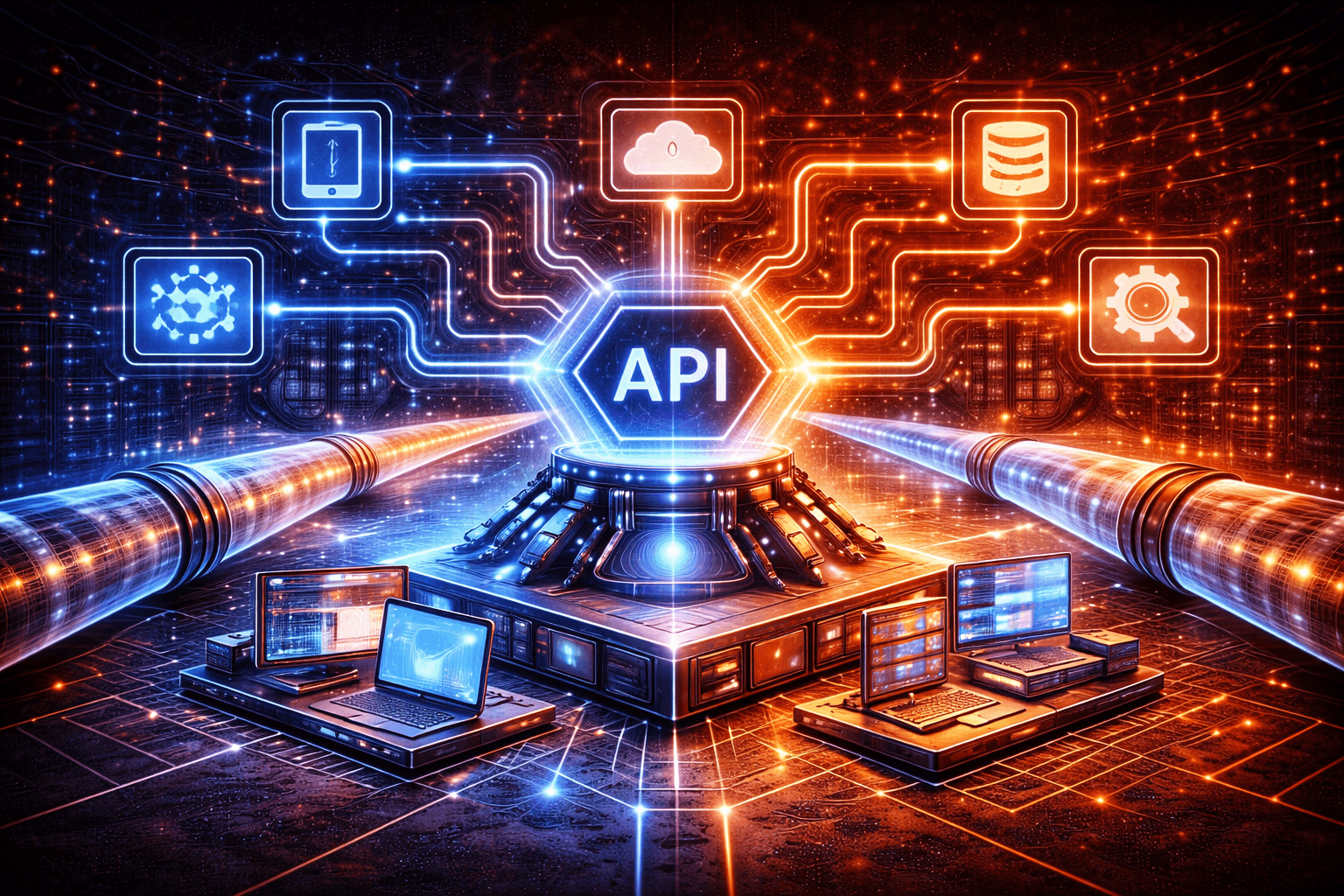
APIs become the architectural foundation.
Why Traditional Architectures Reach Limits
Traditional development often follows:
- Monolithic applications
- Direct database coupling
- Custom point-to-point integrations
- Afterthought interfaces
This leads to challenges when:
- Expanding systems
- Scaling workloads
- Integrating third-party services
- Connecting AI systems
- Extending to mobile or web platforms
API-First eliminates these structural bottlenecks.
Advantages of an API-First Strategy
1. Scalability
APIs support:
- Modular system design
- Microservices architecture
- Load balancing
- Cloud-native scaling
Growth becomes technically manageable.
2. Integration Readiness
Clearly defined APIs allow easy integration with:
- CRM systems
- ERP solutions
- Payment providers
- AI services
- External partners
Integration becomes standardized rather than improvised.
3. Technological Independence
Frontend and backend are decoupled.
This enables:
- Technology replacement flexibility
- Parallel development teams
- Faster innovation cycles
4. Future-Proofing
New channels (mobile apps, IoT, web applications) can use the same backend APIs.
The core infrastructure remains stable.
API-First and AI Systems
Modern AI applications require:
- Clean data interfaces
- Access to structured workflows
- Real-time information streams
Without API-first architecture, AI integration becomes complex and unstable.
API-first is therefore foundational for scalable AI deployment.
Architectural Principles in API-First Environments
- REST or GraphQL APIs
- Version control
- Authentication and authorization
- Comprehensive documentation (OpenAPI)
- Monitoring
- Rate limiting
- Robust error handling
APIs must be secure, stable, and observable.
Practical Example
A company initially built a monolithic platform.
Challenges included:
- Difficult mobile integration
- Complex CRM connectivity
- Expensive AI integration
After transitioning to API-first architecture:
- Clear separation between frontend and backend
- Faster feature releases
- Easier third-party integrations
- Scalable AI connectivity
Architecture shifted from bottleneck to growth enabler.
Common Mistakes
- Treating APIs as secondary
- Lack of documentation
- Weak security design
- Monolithic backend dependencies
- No versioning strategy
API-first is not a technical detail.
It is strategic system design.
ROI Perspective
API-first reduces:
- Integration costs
- Development friction
- Maintenance complexity
- Time-to-market
Over time, it creates technological agility.
Conclusion
API-first is not a trend.
It is the foundation of scalable, modern software architecture.
Organizations that want systems to grow
must design interfaces first.